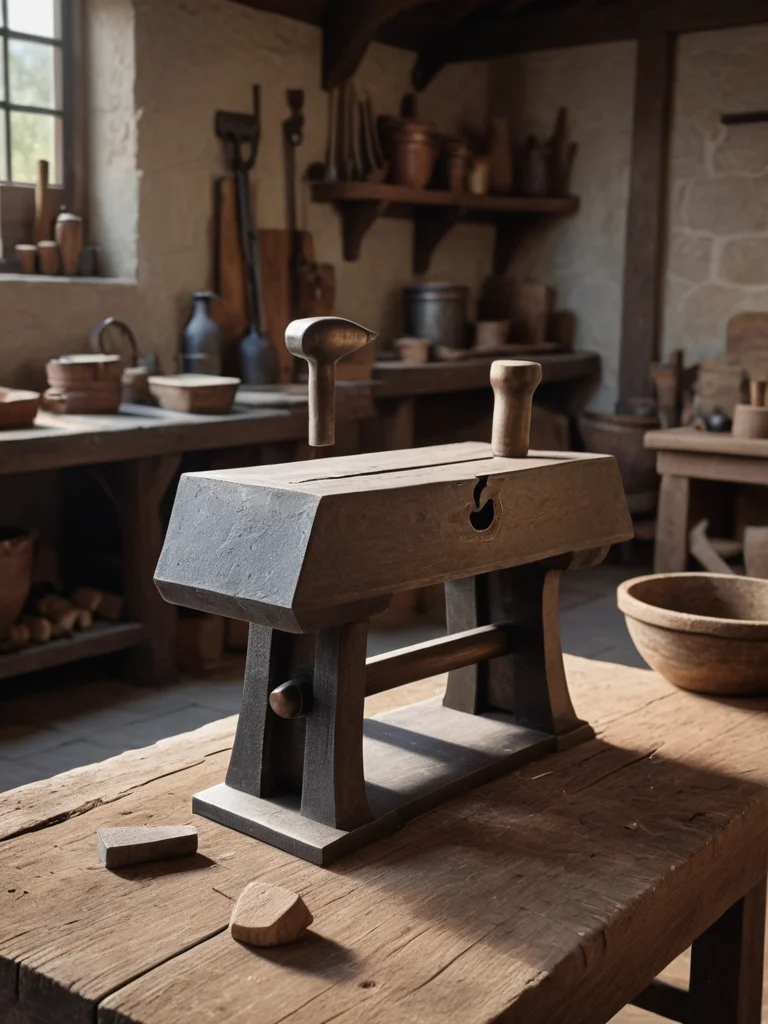
The Middle Ages, a period often associated in the popular imagination with knights in shining armor and majestic castles, was also an era of incredible flourishing of crafts and technological progress. It was then, thanks to the ingenuity and diligence of the masters, that the foundations of many technologies were formed, which became the bedrock of modern civilization. From simple hand tools forged in fiery furnaces to complex mechanisms powered by the forces of nature, every element of medieval craftsmanship was part of a grand story of creation and innovation that transformed people’s daily lives and the face of the entire continent.
The Power of the Middle Ages: How Simple Tools Changed the World of Craftsmen
Medieval Europe, contrary to popular misconceptions of its “darkness,” was a time of continuous technological development. At the heart of this progress lay tools. Lacking complex mechanisms or automation, medieval tools were the result of a deep understanding of materials, physical principles, and human needs. Historians emphasize that it was simple yet effective implements that significantly improved agricultural practices, leading to increased yields and, consequently, population growth and the emergence of cities. For example, the improvement of the moldboard plow, which better turned over heavy European soils, was a revolution in agriculture, ensuring food security and freeing up labor for other activities.
Moreover, tools became a key factor in the construction revolution. The erection of grand cathedrals, impregnable fortresses, and majestic castles, which still amaze us today, would have been impossible without chisels, hammers, levels, and lifting mechanisms, often powered by human or animal muscle. Every stone, every beam required precision and skill achieved through specialized tools. These tools were not just objects of labor; they were an extension of the master’s hands, the embodiment of his vision, and the key to his productivity. They enabled humans to transform the world around them, to master nature, and to create objects that served generations. Not only the efficiency of work depended on them, but also the quality of life – the quality of housing, clothing, and utensils, which in turn affected the health, comfort, and safety of every inhabitant of the Middle Ages. Thus, these seemingly simple implements were the true engines of progress, shaping the economy, social structure, and cultural heritage of an entire era.
The Basic Toolkit of a Medieval Master: Tools Without Which There Would Be No Civilization
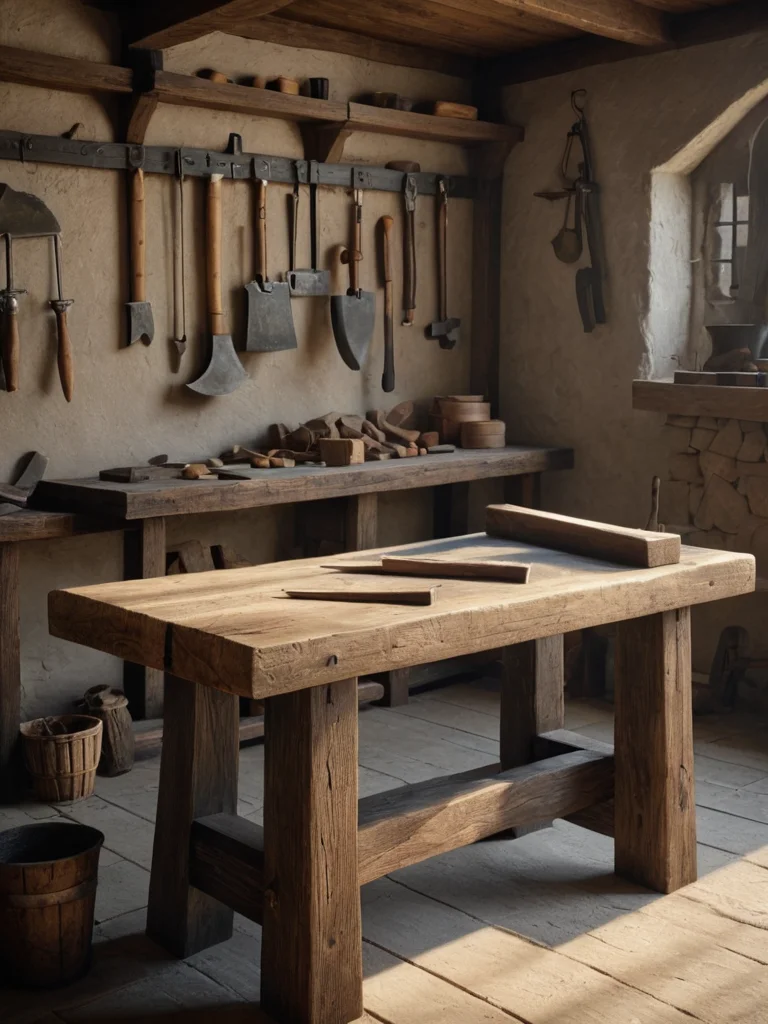
Before delving into specialized crafts, let’s consider the universal set of tools that virtually no medieval master could do without. These “building blocks” of the craft world formed the basis for any professional activity, from carpentry to blacksmithing, from masonry to shoemaking. Their design was simple, but their effectiveness was proven by centuries of use.
- Hammer: This was perhaps the most versatile tool. There was a huge variety of its forms – from heavy blacksmith hammers capable of shaping hot metal to light carpentry hammers for driving nails or assembling delicate joints. They were usually made of iron, with handles of strong wood. The shape of the striking part, weight, and balance were chosen for the specific task, allowing for precise and powerful blows.
- Chisel and Gouge: These tools were indispensable for working with wood, stone, and metal. Stone chisels had sturdy, blunt tips capable of withstanding hammer blows on hard rock. Wooden gouges, with their sharp blades and comfortable handles, were used for creating grooves, tenons, and other carpentry joints. Metal chisels for working with metal were used for trimming or cutting out holes.
- Saw: Although the process of making high-quality saws with fine, sharp teeth was labor-intensive, they were vital for woodworking. Various types of saws existed: bow saws, frame saws, two-handed saws for cutting logs, and hand saws for finer work. Blades were made of steel, and sharpening required special skill.
- Axe: A universal tool for working with wood. Medieval axes were used not only for felling trees but also for rough hewing logs and creating elements of wooden structures. There were both heavy carpenter’s axes for shaping beams and lighter ones for fine work.
- File and Rasp: These tools were used for fine surface finishing, shaping, and removing excess material. Files, with their fine teeth, were used for metal and wood, while rasps, with coarser teeth, were used for wood and stone.
- Measuring and Marking Tools: Even without modern standards, medieval masters used a range of tools to ensure accuracy: squares for right angles, plumb bobs for vertical orientation, and levels (often simple water levels) for horizontal. Marking was done with compasses, scribes, and marking knives.
These basic tools, though they seem simple to us today, required the master not only physical strength but also a deep understanding of the material, precision of movement, and many years of experience. They were a symbol of mastery and independence, allowing the craftsman to create valuable items almost from scratch, relying only on his hands and mind.
From the Forge to the Potter’s Wheel: Secrets of Unique Tools for Different Professions
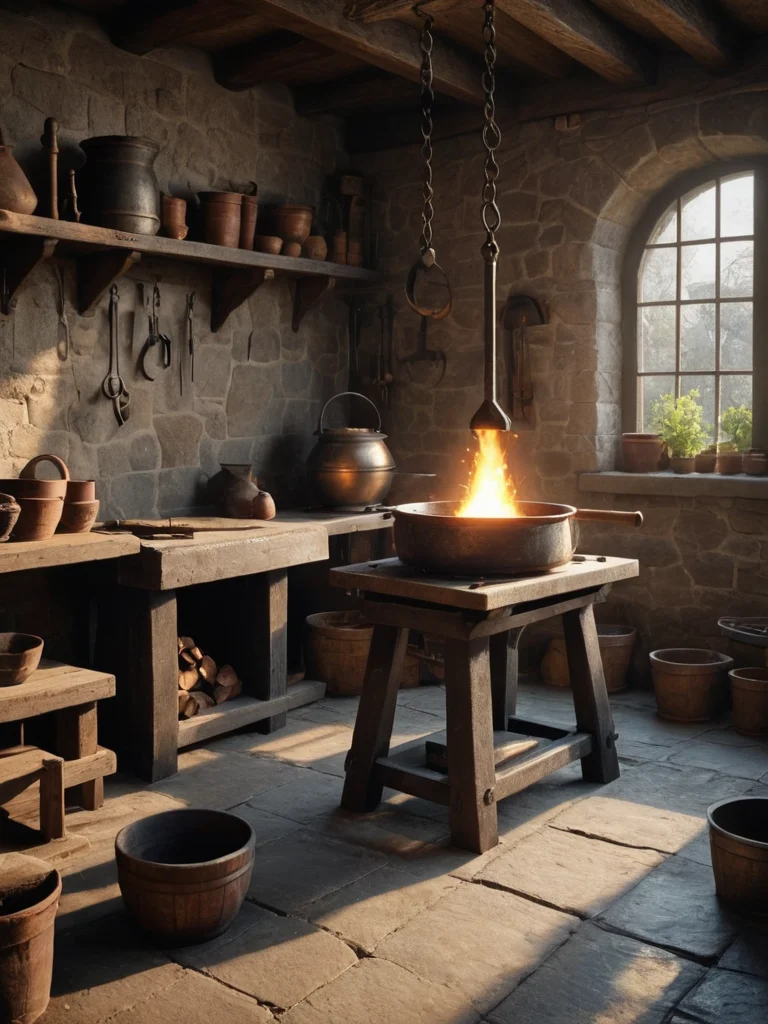
Each medieval craft had its own unique set of specialized tools designed to perform specific tasks with maximum efficiency. These tools were the product of centuries of experience and improvements passed down from generation to generation. It is in their form and function that the secrets of the mastery of medieval craftsmen lie.
- Blacksmithing: The Power of Fire and Metal. The central place in the forge was occupied by the anvil – a massive metal block that served as a support for forging. Its shape, with a horn and a flat surface, allowed for various operations: from drawing out and bending metal to punching holes. Tongs of various sizes and shapes were indispensable for holding hot metal. Blacksmiths’ hammers differed in weight and shape, allowing them to shape metal with powerful or precise blows. The forge (furnace for heating metal) and bellows, which supplied air, were critically important for achieving the desired temperature. Specialized chisels for cutting metal, punches for creating holes, and stamps for creating relief were also used.
- Carpentry and Joinery: The Art of Working with Wood. In addition to basic axes and saws, carpenters and joiners used adzes – tools similar to an axe but with a blade perpendicular to the handle, which allowed for hewing logs and giving them a flat shape. Planes, often made entirely of wood, were used for smoothing surfaces and creating smooth, clean cuts. Gouges of various sizes were used for precisely carving grooves and tenons, necessary for creating strong joinery without the use of nails. Augers, precursors to modern drills, were used for creating holes. A miter box, a simple device for precise angled sawing, was indispensable for making furniture and decorative elements.
- Masonry: Grandeur in Stone. Masons used specialized mallets, chisels (thin stone chisels), and bush hammers (hammers with teeth for texturing surfaces). Plumb bobs and levels were critically important for ensuring the verticality and horizontality of the masonry, especially when building multi-story buildings and vaults. Picks and tongs helped lift and position heavy stone blocks, and templates made of wood or parchment were used for precisely cutting complex architectural elements.
- Pottery: Clay in the Master’s Hands. The potter’s main tool was the potter’s wheel, powered by foot or hand. It allowed for centering clay and creating symmetrical vessels. Ribs – wooden or bone sticks of various shapes – were used for shaping. A cutting wire was used to separate the finished piece from the wheel. Kilns, built for firing clay, were also complex technological structures requiring precise temperature control to produce durable and waterproof items.
- Textile Production: Thread by Thread. In fabric production, looms played a key role, which could be simple vertical looms for creating narrow fabrics or more complex horizontal looms, allowing for weaving wide fabrics. Spindles and spinning wheels were used to turn wool, flax, or cotton into thread. Shuttles passed the weft (crosswise thread) through the warp. Wool combs and scissors were also necessary.
Each of these tools required the master not only knowledge of his craft but also an intuitive understanding of the material he was working with. They were not just passive objects but active participants in the creative process, allowing medieval craftsmen to achieve incredible results with seemingly simple technologies.
The Power of Water and Mind: How Medieval Craftsmen Transformed Nature into Technology
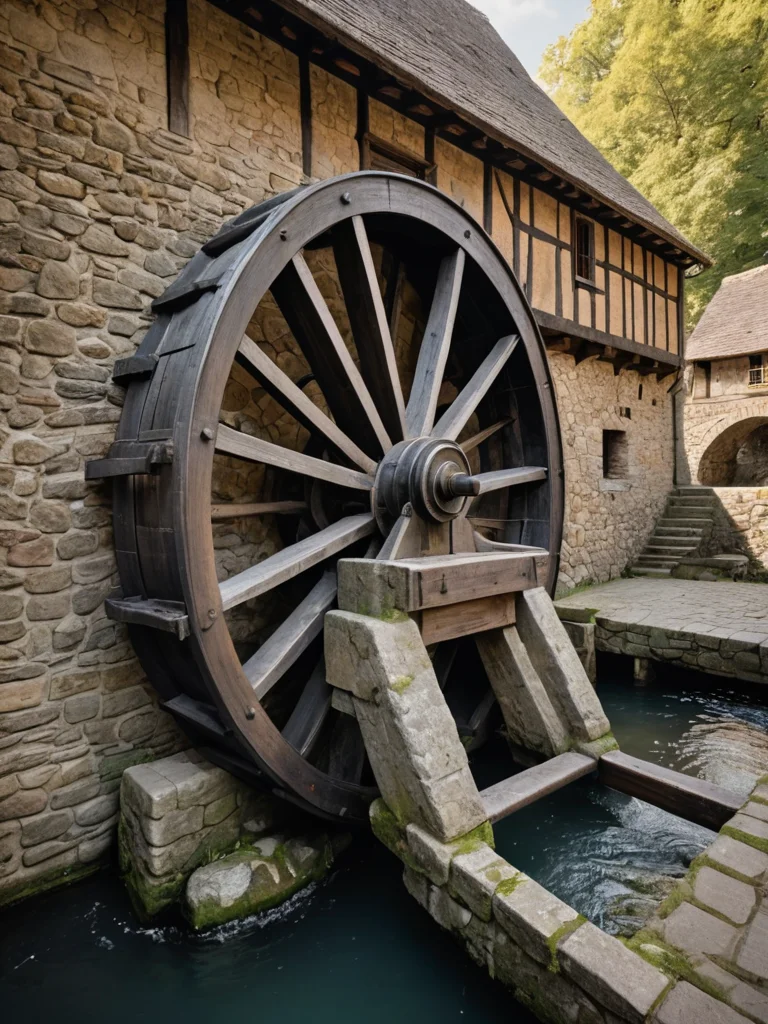
The Middle Ages witnessed a remarkable development of large-scale technologies that far surpassed the capabilities of manual labor and demonstrated a deep understanding of natural forces by the masters. Historians often refer to this period as the “water mill revolution,” emphasizing their dominant role in the economy and daily life. These complex mechanisms were not just individual inventions; they represented entire systems capable of converting the kinetic energy of water or wind into useful mechanical work, thereby multiplying labor productivity.
- Water Mills: The Engines of Medieval Progress. Water mills were perhaps the most significant technological breakthrough of the Middle Ages. Their primary purpose was grain milling, which made bread more accessible and freed up thousands of hands from the arduous task of manual grinding. However, their applications were much broader:
- Fulling Mills: Water wheels powered heavy hammers that compacted fabric (the process of fulling), making it stronger and more waterproof. This significantly accelerated textile production and improved its quality.
- Forging Hammers: Water could power enormous hammers used in large forges for working iron and other metals. This allowed for the production of larger and more complex metal products, including weapons and tools.
- Sawmills: The first mechanical sawmills, also powered by water, significantly accelerated the sawing of logs into planks, which was critical for construction.
- Water Pumps: Mills could be used for pumping water, for example, out of mines or for irrigation.
Water mills required serious engineering knowledge for the construction of dams, canals, and the design of the wheel and transmission mechanisms themselves. They transformed the economic landscape, becoming centers of industrial production and often the nucleus of settlements.
- Windmills: The Power of Wind at the Service of Man. In regions where rivers were shallow or absent, windmills became widespread. They were particularly popular in Northern Europe, for example, in the Netherlands, where they were used not only for grinding grain but also for draining land. Technologically, windmills were no less complex, requiring systems for rotating the body or blades to catch the wind depending on its direction.
- Lever and Pulley Systems: Architectural Wonders. For the construction of majestic cathedrals and castles, which required lifting enormous stone blocks and beams to significant heights, medieval masters actively used the principles of mechanics. Levers, capstans, and complex pulley systems, often powered by teams of workers or draft animals, allowed for the movement of loads that would be absolutely impossible for one person to lift. This was not just knowledge of physics but an art of applying it in large-scale engineering projects.
- Screw Presses: From Wine to Books. Screw mechanisms, using the principle of the inclined plane, found wide application in presses. Initially, they were used for producing wine and oil, but with the development of paper and, especially, the invention of printing in the 15th century, screw presses became the basis for printing presses, revolutionizing the dissemination of knowledge.
These technologies, powered by the forces of nature, were a true symbol of human intellect and engineering thought. They not only significantly increased labor productivity but also laid the groundwork for future industrial revolutions, demonstrating how seemingly simple principles could be scaled up to solve colossal problems and transform society.
The Legacy of Past Eras: What Lessons from Medieval Masters Offer Us Today
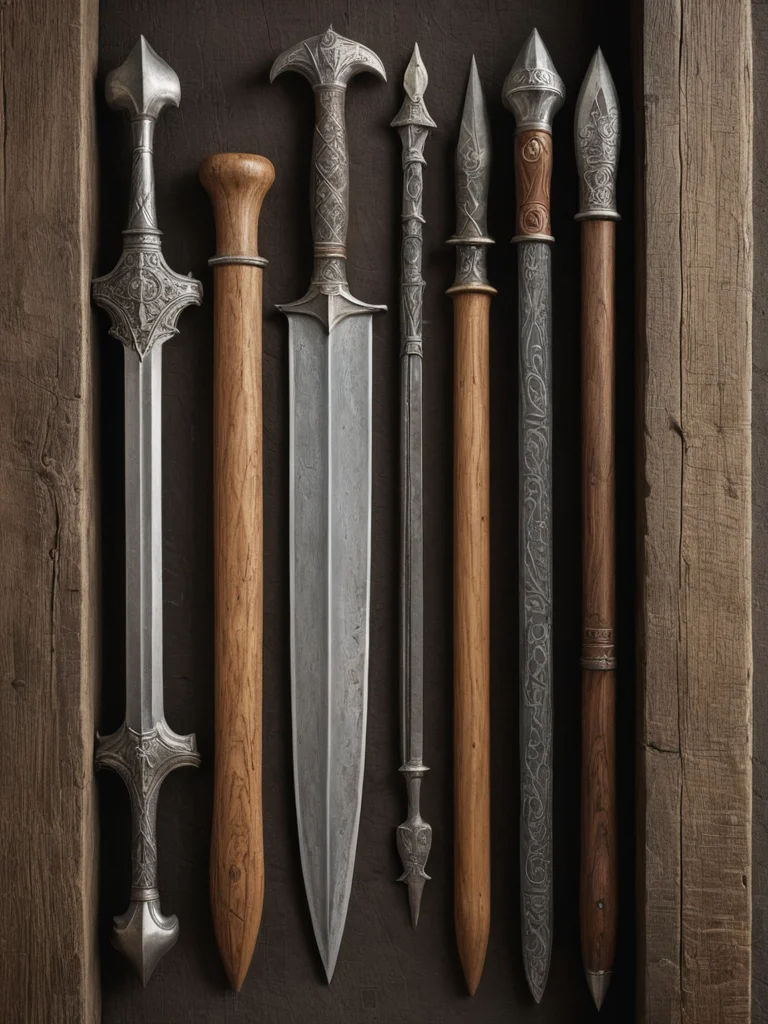
As we conclude our journey into the world of medieval tools and technologies, we inevitably ask ourselves: what can the lessons of masters from past eras offer us in today’s highly technological world? The answer, as is often the case with history, lies much deeper than it appears at first glance and goes beyond simply studying the past. The legacy of medieval craftsmen not only enriches our understanding of history but also offers valuable guidance for the present.
Firstly, it is the value of manual labor and craftsmanship. In an era of mass production and disposable goods, where many items lose their value after the first use, we are beginning to re-appreciate what is created by the hands of a master. Medieval craftsmen invested not only labor but also soul, knowledge, and years of experience into their creations. Their works were distinguished by durability, repairability, and unique aesthetics. Today, this principle is being revived in the sustainability movement, in the interest in artisanal products, and in the idea of “slow production,” where quality and individuality are valued above speed and volume.
Secondly, it is ingenuity with limited resources. Medieval masters did not have access to modern materials or energy sources. However, they learned to make the most of what was at hand: wood, iron, stone, clay, the power of water and wind. They created amazing things, demonstrating how significant results could be achieved by relying on a deep understanding of natural principles and the efficient use of available means. This lesson is particularly relevant in light of modern challenges such as climate change and the need for more rational resource consumption.
Thirdly, it is the importance of knowledge transfer and continuity. The guild and apprenticeship system in the Middle Ages ensured not only the preservation but also the development of craft traditions. Young masters learned from experienced ones, inheriting secrets and techniques that had accumulated over centuries. This approach to education and experience sharing serves as a model for modern vocational training systems, where practical skills and mentorship are valued. It reminds us that knowledge is not just information but a living tradition that requires constant renewal and transmission from hand to hand.
Finally, medieval tools and technologies are a powerful reminder that humans, armed with only basic implements and their intellect, are capable of creating wonders. From the construction of magnificent cathedrals to the creation of exquisite works of art, from mastering nature to organizing complex production – all this was achieved through the genius and perseverance of those whom we today call medieval craftsmen. Their story is a story of how the human spirit, embodied in tools, is capable not only of adapting to the world but also of actively transforming it, leaving behind a majestic and inspiring legacy that remains relevant even after centuries.