Imagine a world where justice was not dispensed in stuffy courtrooms with juries and lawyers, but under the open sky, where God himself could be the judge, and the proof of innocence was a red-hot poker. Welcome to the medieval justice system – a world simultaneously primitive and deeply symbolic, cruel and paradoxically rational for its time. For a modern person, many aspects of medieval courts may seem wild and unfair. However, if we look deeper, we see not just a chaotic system, but a complex mechanism that attempted to establish order in a society based on faith, tradition, and very limited scientific knowledge.
Historians emphasize that medieval legal systems were extremely diverse. There was no single “medieval law,” as each region, each feudal estate, each city, and even each guild could have its own statutes and customs. Alongside them operated the powerful systems of ecclesiastical (canon) law and the reviving Roman law, which gradually began to influence secular courts. This mosaic of legal norms often led to confusion, but also allowed the system to be flexible enough to adapt to local conditions and community needs. The most important difference from the modern understanding of justice was the lack of a clear separation between the secular and the divine. It was believed that justice, ultimately, came from God, and it was this belief that underpinned many judicial practices.
When God Was the Judge: Trials by Fire, Water, and Duel
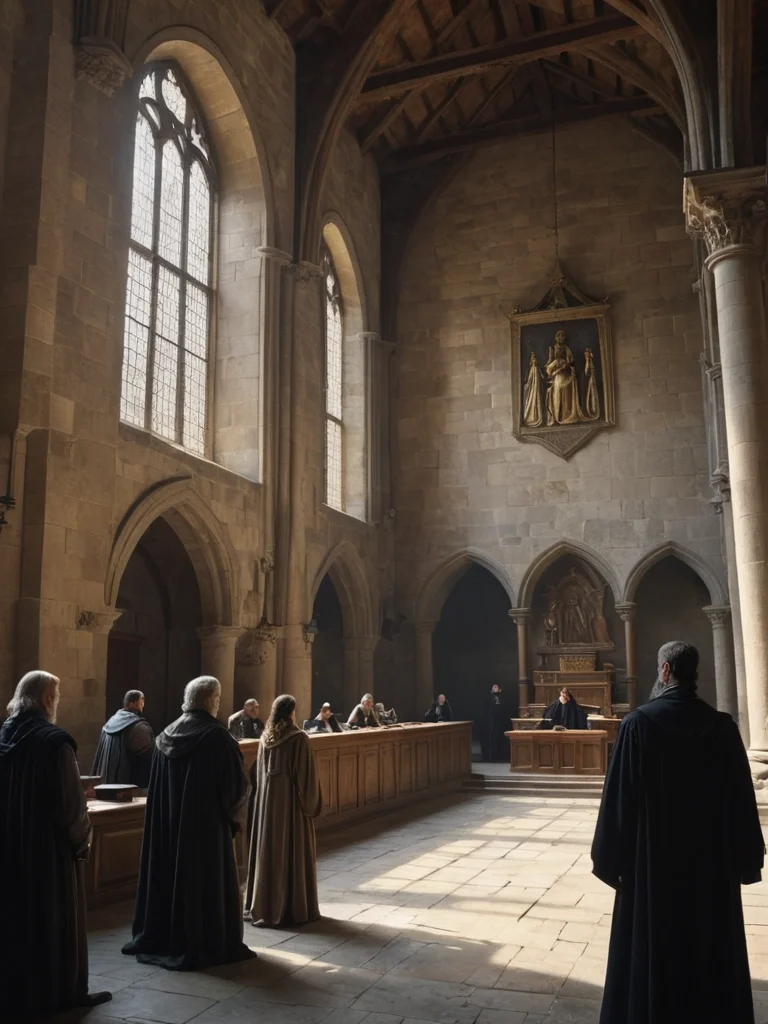
One of the most famous and perhaps most terrifying forms of medieval justice was the so-called “trial by ordeal,” or ordalium. These were ritualistic trials based on the deep belief that the Almighty would not allow the innocent to be condemned and would grant a sign of truth. Such trials were intended for cases where there was no direct evidence of guilt or innocence, and witness testimonies contradicted each other. The purpose of the ordeal was not so much to ascertain facts as to appeal to higher powers for a final verdict that no one could dispute. It is important to understand that in the eyes of a medieval person, this was not arbitrary but a perfectly logical way to resolve a dispute in conditions where rational methods of proof were still very underdeveloped.
Among the most common trials by fire was walking over red-hot ploughshares or holding a red-hot iron in one’s hand. The accused, usually after prayer and a priest’s blessing, had to walk a certain distance over hot ploughshares or carry a hot object for several steps. Then, the hand or feet were carefully bandaged, and after three days, the bandage was removed. If the wounds healed cleanly, without pus or severe inflammation, it was considered a sign of God’s grace and innocence. If the wounds were serious, it indicated guilt. Historians note that despite the apparent inhumanity, there were certain tricks: for example, some accused could rub their skin with special compounds that reduced burns, and priests could interpret the result depending on their attitude towards the accused or the influence of interested parties. Nevertheless, the fear of punishment and the belief in divine intervention were so strong that many accused preferred to confess rather than undergo this ordeal.
Trial by water, both hot and cold, was also widespread. In the case of hot water, the accused had to dip their hand into boiling water to retrieve an object – a ring or a stone – from the bottom of a pot. The consequences were assessed in the same way as in the trial by fire. Trial by cold water was most often used against suspected witches and sorcerers, especially in the later Middle Ages and early modern period. The accused was bound (right hand to left leg, left to right) and thrown into a body of water. If the person sank, it was considered a sign of innocence, as “pure water” accepted them. If they remained on the surface, it was interpreted as rejection by the water, a symbol that “evil nested” within them and they were guilty. This type of ordeal was particularly treacherous, as surviving it was extremely difficult, and death often meant posthumous acquittal, which, however, offered little comfort to the living.
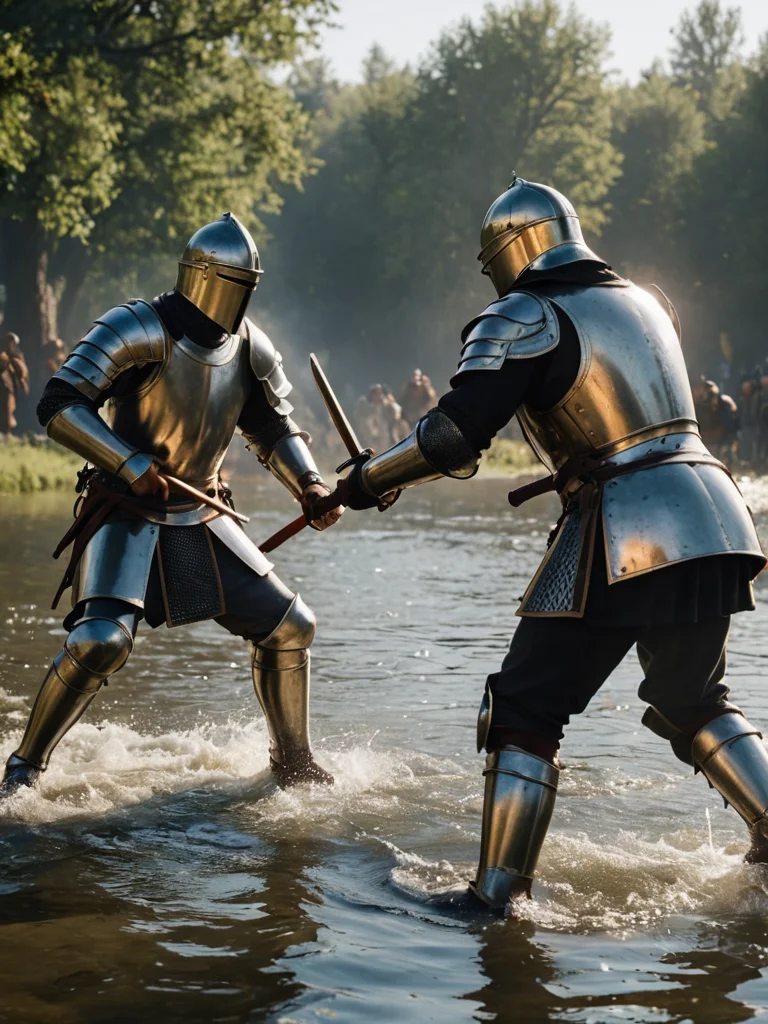
The judicial duel, or “trial by combat,” was another form of ordeal, where not only God but also one’s own physical strength and skill with weapons acted as the judge. It was particularly popular among the nobility and warriors, as it allowed disputes of honor and dignity to be resolved. It was believed that God would grant victory to the righteous. Both parties, the accuser and the accused, or their specially hired “champions,” would engage in combat. The outcome of the duel was considered the final decision of heaven. The rules were strict: the duel was conducted in the presence of judges, with observance of rituals and prayers. Women, the elderly, and the disabled could field fighters instead of themselves. Sometimes, if the accused won, the accuser could be executed for false accusation. This method emphasized knightly ideals and the value of personal valor in medieval society.
By the beginning of the 13th century, with the development of legal thought and the strengthening of church authority, attitudes towards ordeals began to change. The Church, realizing the unreliability and cruelty of these methods, gradually began to abandon them. In 1215, the Fourth Lateran Council forbade priests from participating in “trials by ordeal,” which marked a turning point in their history. Without the blessing and participation of the clergy, ordeals quickly lost their legitimacy and gradually fell out of use, giving way to new, more rational, though no less controversial, methods of proof.
From Ordeals to Interrogations: The Emergence of Secular and Ecclesiastical Courts
The abandonment of ordeals did not mean the instant appearance of a modern judicial system. It was a long and complex process that spanned several centuries and was closely linked to profound changes in European society. The revival of Roman law, the development of canon law, and the strengthening of monarchical central power played a crucial role in this transition.
The Church, being one of the most educated and organized structures of the Middle Ages, made a huge contribution to the formation of a new legal paradigm. Canon law, based on Holy Scripture, the writings of Church Fathers, and the decrees of papal councils, developed actively. By the 12th-13th centuries, universities appeared where jurists studied and systematized both canon and Roman law. Roman law, with its emphasis on rational proof, written documents, and developed procedural norms, became a powerful counterweight to the irrationality of ordeals. It introduced the concept of the presumption of innocence (albeit in a very limited form) and required evidence, not just divine intervention. Ecclesiastical courts, especially the inquisitorial tribunals, became pioneers in applying the so-called “inquisitorial process,” which differed from the traditional “accusatorial” process. In the accusatorial process, the initiative belonged to the parties (the accuser), and the court acted as an arbiter. In the inquisitorial process, the court itself acted as an investigator, actively gathering evidence, interrogating witnesses, and suspects. This was an important step towards a more active role for the state (or the Church) in the pursuit of truth.
Concurrently, royal power was strengthening. Monarchs sought to centralize administration and create a unified legal system to undermine the authority of feudal lords and local customs. They established royal courts, which gradually displaced feudal ones, offering more predictable and (theoretically) fairer justice. For example, in England, the “Common Law” system developed, which relied on judicial precedents and gradually formed a unified legal space. In France and the German lands, there was a “reception” of Roman law, meaning its active integration into national legal systems. This led to the emergence of professional lawyers, judges, and prosecutors who were educated in universities and possessed knowledge of complex legal machinery. Thus, the court gradually transformed from a ritualistic act into a bureaucratic procedure based on investigation and analysis of information.
This transition was slow and uneven. In some regions, ordeals persisted longer than in others. But the general trend was clear: a move away from mystical methods and towards rational ones, based on gathering testimony and evidence. Nevertheless, the “rationality” of medieval justice had its dark sides, especially when it came to the methods of obtaining this very testimony.
The Voice of Truth: Interrogation Methods and the Role of Witnesses in the Middle Ages
With the transition to the inquisitorial process and the desire to obtain “hard” evidence, interrogation took center stage in judicial practice. Unlike today, where an accused’s confession is just one piece of evidence, in the Middle Ages, especially in the late medieval and early modern periods, confession was considered the “queen of evidence” (regina probationum). This was logical: if a person themselves admitted to committing a crime, why look for anything else? The problem lay in the methods of obtaining this confession.
It was during this period that the use of torture became legitimized and widespread. It is important to understand that torture was not arbitrary violence; it was part of the legal procedure and was often regulated by quite complex rules that seem incredibly cynical today. Torture was not used for punishment, but to obtain “true” information, i.e., a confession. According to the legal understanding of the time, no one would voluntarily confess to a serious crime unless they were under the influence of the devil or under severe duress. Therefore, torture was considered a necessary evil, a way to break the will of a liar and extract the truth from them.
There were various types of torture used depending on the region and the severity of the crime. Among the most common were:
- The Rack: A device that stretched a person’s joints, causing unbearable pain and often leading to dislocations and ligament tears. The goal was to make the person “stretch” and tell the truth.
- Strappado: The accused’s hands were tied behind their back, and then they were lifted by a rope, dislocating their shoulder joints. Weights were often attached to their feet to intensify the effect.
- Water Torture: There were several variations. In one case, the accused was forced to drink a huge amount of water, causing agonizing pain and a feeling of internal organs bursting. In another, water was poured onto a cloth placed over the face, simulating suffocation.
- Thumbscrews (Boot): Tools for crushing the fingers or toes, as well as the shins, causing bone fractures.
The use of torture was generally not uncontrolled. It often required a judge’s permission, and there were limitations: for example, one could not be tortured twice for the same accusation (although “continuation” of torture was possible), and a confession obtained under torture had to be “confirmed” by the accused without torture. If the person refused to confirm their confession, they could be tortured again, or their testimony could be considered invalid. However, in practice, torture often led to false confessions, as anyone under unbearable pain was ready to say anything to stop the torment. Inquisitors, for example, were trained to recognize a “true” confession, but their criteria were far from objective.
The role of witnesses was also important, although it differed from today. Witness testimonies carried weight, but their value depended on the status of the witness. The testimony of a noble person or a priest was valued more than that of a commoner, let alone a woman or a serf. Sometimes a certain number of witnesses were required to establish a fact – for example, “two witnesses” were needed to confirm many accusations. Oaths played a huge role: a witness swore to tell the truth on the Gospels, and a false oath was considered a grave sin that could lead to divine punishment. Nevertheless, the possibility of bribery, intimidation, or simply error by witnesses was as real as it is today, but the tools for verifying their testimony were extremely limited.
Unlike the modern system, where the accused has the right to a lawyer, to review case files, and to refuse to testify, such rights did not exist in medieval courts. The accused was an object of investigation, not a subject with rights. Defense, if it existed at all, was extremely weak and depended on the judge’s will or the presence of patrons. All of this created a system where the search for “truth” could be highly biased and relied on methods that shock today with their cruelty and unreliability.
The Verdict and Legacy: How Medieval Justice Shaped Our Understanding of Law
After lengthy procedures, interrogations, and sometimes torture, came the moment of sentencing. Punishments in the Middle Ages were diverse and often had a demonstrative, public character, intended to intimidate and serve as a lesson for society. The severity of the sentence depended on the gravity of the crime, the status of the accused, and local customs. The purpose of punishment was not only retribution but also the restoration of violated order – both social and divine.
Among the most common punishments were:
- Fines and Compensation: For less serious offenses, especially those involving property or bodily harm, fines (wergild) or compensation to victims were often applied. In the early Middle Ages, this was the primary way to avoid blood feuds.
- Corporal Punishment and Mutilation: The pillory, whipping, branding, amputation of hands (for theft), gouging out of eyes – all were part of the arsenal of justice. These punishments not only inflicted pain but also branded the criminal, making them an outcast in society.
- Exile and Deprivation of Civil Rights: For certain offenses, especially against public morals or order, exile from the city or community was applied, as well as the loss of honor and civil rights, which meant the loss of social status and legal protection.
- Capital Punishment: The ultimate penalty, applied for the most serious crimes: murder, treason, heresy, witchcraft. Methods of execution were diverse and often characterized by particular cruelty and publicity: hanging, beheading, burning at the stake (especially for heretics and witches), breaking on the wheel, and quartering for particularly grave crimes and traitors. Public executions were important events, attracting crowds; they served not only as an act of retribution but also as a grand spectacle intended to assert power and justice.
Executions were often accompanied by religious rites, which emphasized their moral and spiritual significance in the eyes of society. It was believed that through execution, the criminal not only atoned for their guilt before society but also, possibly, saved their soul if they showed repentance.
The legacy of medieval justice for the modern understanding of law is ambiguous, but undeniably significant. Despite its cruelty and reliance on doctrines that seem absurd today, it was in the Middle Ages that the foundations of many modern legal institutions and principles were laid.
- Development of Procedural Law: The abandonment of ordeals and the transition to the inquisitorial process contributed to the development of more complex procedures for proof, gathering witness testimony, and analyzing evidence, which became the precursor to modern investigative methods.
- Codification and Systematization: The revival of Roman law and the development of canon law led to attempts at codifying and systematizing legal norms, which formed the basis for creating legislative codes.
- Emergence of Legal Professions: The increasing complexity of legal systems led to the emergence of professional lawyers, judges, prosecutors, and notaries – individuals whose activities were unthinkable in the early Middle Ages and who became the pillars of modern legal systems.
- The Concept of Crime Against the State: As monarchies strengthened, crimes began to be viewed not only as personal offenses but also as violations of public order, i.e., crimes against the state or the crown, which is a fundamental principle of modern criminal law.
- Some Foundations of Legal Guarantees: Although the rights of the accused were extremely limited, it was in the Middle Ages that the seeds of ideas appeared that would later develop into concepts such as the jury trial (in England), the right to appeal, and certain procedures designed to protect against complete arbitrariness.
Thus, medieval justice was a dynamic and constantly evolving system. It reflected the faith, values, and social structures of its time. From “trials by ordeal,” where fire and water decided a person’s fate, to complex interrogations involving torture, from cruel public executions to the first steps towards rational proof – this era served as a bridge between archaic legal customs and the nascent modern legal state. By studying it, we better understand how our current understanding of justice, law, and human rights was formed.