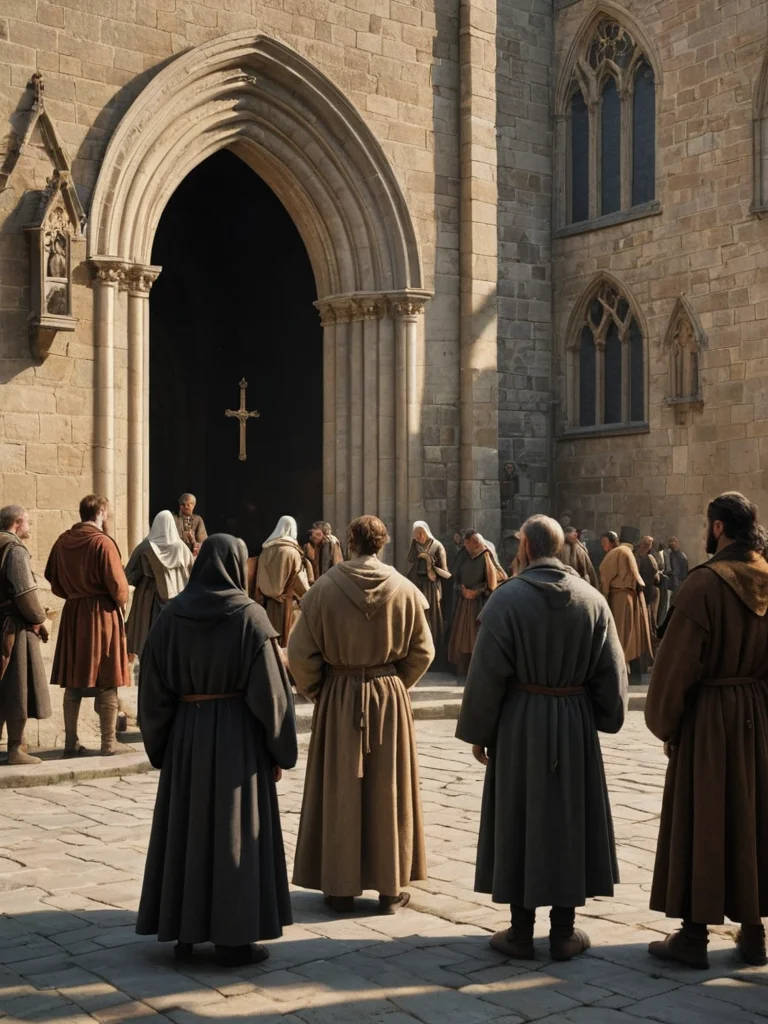
Medieval Europe, as historians know, was a world deeply permeated by religious beliefs. The Catholic Church was not just an institution, but the foundation of social life, a powerful force that shaped the worldview, culture, politics, and even the daily lives of every person. From the baptism of an infant to the burial of an elder, from the royal court to the peasant hut – its influence was all-encompassing. The Church possessed not only spiritual authority but also vast landholdings, influence over education, jurisdiction over souls, and, at times, even over bodies. It was the Church that determined what was truth and what was error, what was permissible and what was sin. Any deviation from its doctrines was perceived not merely as a mistake, but as a mortal danger to the soul, a threat to public order, and the divinely ordained structure of the world.
Nevertheless, even under such monolithic control, throughout the Middle Ages, especially from the 11th-12th centuries onwards, movements that we today call heresies regularly arose and spread. These movements offered their own views, often radically different from the official ones, on faith, church hierarchy, sacraments, and even the nature of God. For many modern readers, it may seem surprising why, in an era when faith was so strong and the Church so powerful, people dared to go against the current, risking their reputation, property, and even their lives. However, as research shows, these searches for an alternative were not random deviations; they were a complex response to the deep social, economic, political, and, of course, spiritual needs and challenges of the time. Heresies were not just “errors in faith”; they often became a mirror reflecting the sore points of society, its aspirations, and its striving for a deeper, purer, or, conversely, a more rational understanding of the divine. We invite you to delve into this fascinating world of medieval dissent together to understand what drove these people and why their ideas proved so appealing to thousands of believers seeking God outside the established framework.
To fully grasp the phenomenon of medieval heresies, it is important to discard stereotypes and view these movements not as marginal sects, but as significant cultural and religious phenomena. Historians emphasize that many heretical teachings arose not from a desire to destroy Christianity, but, on the contrary, from a desire to return it to its original purity, to the ideals of the early apostolic community, which, according to critics, had been lost by the Church in the course of its formation as a powerful secular institution. It was a sincere, deeply personal search for God, which, however, ran counter to established dogmas and hierarchy. Thus, heretics were not simply apostates; they were often zealous believers whose conscience and reason could not reconcile themselves with the existing order of things, which pushed them onto the path of alternative spiritual quests.
Not Just Sin: The True Causes of Heresies in the Middle Ages

For many centuries, the official Church presented heresy exclusively as malicious distortion of truth, the devil’s machinations, or the result of pride and ignorance. However, modern historians and sociologists of religion view this phenomenon much more broadly, identifying a whole complex of factors that contributed to the emergence and spread of heretical movements in the Middle Ages. Often, these were not just theological disputes, but reflections of deep social, economic, and political changes that shook society at the time.
One of the main reasons, undoubtedly, was the socio-economic situation. The Middle Ages, especially its High period (11th-13th centuries), was a time of rapid urban growth, development of trade and crafts, but also a time of immense social inequality. The Church, being the largest landowner and accumulator of wealth, was often perceived by ordinary people as part of the oppressive class. Bishops and abbots lived in luxury, while peasants and the urban poor barely made ends meet. This caused deep discontent and disappointment. Heretical movements, such as the Waldensians or Cathars, often preached poverty, renunciation of worldly goods, and criticized the wealth and corruption of the clergy. Their calls for apostolic poverty found a lively response among those suffering from need and injustice. People saw a stark contrast between the proclaimed evangelical ideals and the real lives of church officials, which undermined the authority of the official Church.
Political factors also played an important role. As centralized monarchies strengthened in Europe, kings and emperors increasingly came into conflict with the papacy for power and influence. In some cases, heresies could be used as a tool in this struggle: local princes might provide covert support to heretics to weaken the influence of bishops and Rome in their territories. Furthermore, the growth of cities led to the emergence of new social strata – merchants, artisans, who were more independent of the feudal system and, consequently, of the Church as its support. These urban dwellers were often more educated and open to new ideas, including alternative religious teachings. They sought a more personal and less formalized connection with God, which the official liturgy did not always provide.
Theological and spiritual reasons were no less important. Despite strict control, there was a certain spiritual ferment in the Middle Ages. People craved a deeper understanding of Scripture, a more sincere faith. The official Church, with its complex rituals and Latin liturgical language, often seemed distant and incomprehensible. Many heretics, on the other hand, offered a direct connection with God, preached in vernacular languages, and called for personal reading of the Bible. They drew attention to discrepancies between Christ’s teachings and the Church’s practices – for example, the sale of indulgences, simony (the sale of church offices), and the immoral behavior of some priests. These issues were not mere idle reflections, but sharp challenges for deeply religious people who sincerely sought salvation. The desire to return to “pure” Christianity, an idealized image of the apostolic community, was a powerful motive for many. People wanted to see their pastors as models of holiness, not as embodiments of worldly vices. This spiritual hunger, the striving for authenticity, combined with growing disappointment in hypocrisy and corruption within church structures, created fertile ground for the spread of heretical teachings, which, according to their followers, offered a more authentic and righteous path to God.
From Cathars to Hussites: Major Heresies and Their Unusual Ideas

The Middle Ages gave the world a whole palette of heretical movements, each with its own unique characteristics, theological doctrines, and social base. Some were local and short-lived, while others encompassed entire regions and influenced the historical process for decades and even centuries. Let’s examine the most significant ones to understand their “unusual ideas” and why they differed so greatly from orthodox Christianity.
Perhaps the most famous and powerful heresy was that of the Cathars, also known as Albigensians (after the city of Albi in Languedoc, southern France, where they were particularly strong). This movement, which flourished in the 12th-13th centuries, was based on dualistic beliefs, i.e., the belief in the existence of two equal principles: a good God, the creator of the spiritual world, and an evil god (or Demiurge, identified with the God of the Old Testament), the creator of the material world. For the Cathars, the visible, material world, including the human body, was the creation of evil, a prison for the divine soul. Consequently, they rejected many Catholic dogmas: the resurrection of the body, the reality of Christ’s incarnation (considering him merely a phantom), sacraments, especially the Eucharist, marriage (as an act of perpetuating the material world), and the hierarchical structure of the Church. The Cathars were divided into “perfects” (perfecti), who led an extremely ascetic life (complete abstinence from meat, milk, eggs, asceticism, celibacy), and “believers” (credentes), who could live ordinary lives but strove to approach the ideals of the “perfects” and undergo the rite of consolamentum (spiritual consolation) before death. Their church was an alternative, with its own hierarchy and rituals. Cathar ideas proved unusually appealing to many, especially in southern France, where they found support among the nobility and townspeople tired of the corruption and harshness of the official Church.
Another significant movement was the Waldensians, named after their founder, the Lyonnais merchant Peter Waldo (12th century). Unlike the Cathars, the Waldensians were not dualists and did not deny key Catholic dogmas about the Trinity or the Incarnation. Their “heresy” lay primarily in their call for literal adherence to the evangelical commandments, especially the commandment of poverty. Waldo gave away his possessions to the poor and began to preach in the vernacular, insisting that any believer had the right to preach the Gospel, even if not a priest. They translated parts of the Bible into local languages, which was strictly forbidden by the Church, which considered Latin the only sacred language for Scripture. The Waldensians criticized the wealth of the clergy, rejected indulgences, purgatory, and the cult of saints, considering them later accretions. Their striving for “apostolic poverty” and direct access to Scripture, bypassing the authority of priests, made them dangerous to the Church. Despite persecution, the Waldensians survived and exist to this day, especially in Italy and some other countries, having gone through the Reformation and become one of the Protestant denominations.
In 14th-century England, the Lollard movement arose, closely associated with John Wycliffe, an Oxford professor and theologian. Wycliffe was one of the first to openly oppose papal authority, the doctrine of transubstantiation in the Eucharist, and the wealth and moral decay of the clergy. He argued that the true Church was not the hierarchy headed by the Pope, but the community of the elect. Wycliffe insisted that the Bible was the sole authority for faith and should be accessible to everyone in their native language. He himself began the work of translating the Bible into English, and his followers, the Lollards (which may mean “mutterers” or “idlers”), actively spread these ideas and translations among the common people. The Lollards were precursors to the Reformation, challenging not only church practice but also its very dogmatic foundation. Their ideas had a significant influence on subsequent reformers, including Jan Hus.
Finally, in the 15th century in Bohemia (modern-day Czech Republic), a powerful movement called the Hussites erupted, named after their leader Jan Hus, rector of Charles University in Prague. Hus, influenced by Wycliffe’s ideas, sharply criticized the moral decay of the clergy, the sale of indulgences, and the absolute power of the Pope. His main demands were: communion of the laity under both kinds (bread and wine, whereas ordinary Catholics received only bread), free preaching of the Word of God, prohibition of priests owning worldly possessions, and punishment for mortal sins for the clergy. Although Hus was burned at the stake on charges of heresy at the Council of Constance in 1415, his death only fueled the movement. The Hussites, led by talented commanders such as Jan Žižka, offered fierce resistance to the crusades organized against them. Their struggle had not only a religious but also a strong national Czech subtext, making it particularly powerful. The Hussite Wars became the first major conflict in Europe where religious disagreements escalated into full-scale military confrontation, and their consequences were felt for decades, foreshadowing the coming religious wars of the Reformation era.
These examples demonstrate that medieval heresies were multifaceted: from the deeply philosophical dualism of the Cathars to the practical evangelical poverty of the Waldensians and the socio-religious protest of the Hussites. All of them, however, expressed the urgent need of people for spiritual authenticity and criticized the official Church’s departure from its original ideals, offering their own, “unusual,” but for many, attractive paths to salvation.
The Inquisition and Crusades: How the Church Fought Dissent and What Came of It
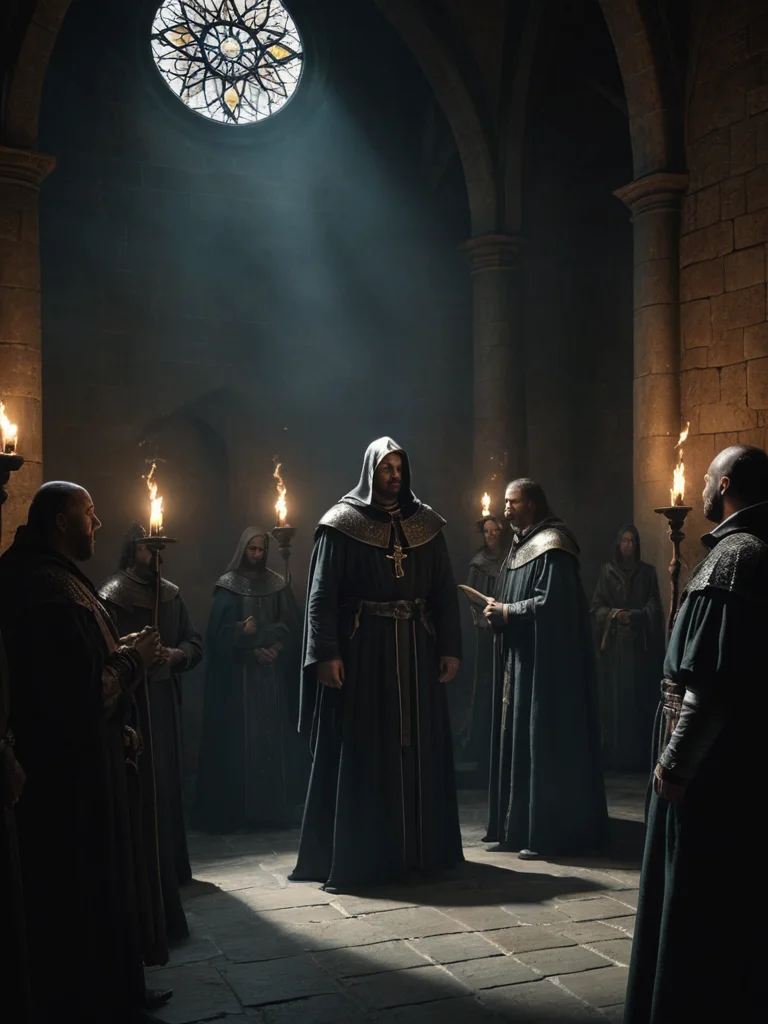
Faced with the growth and spread of heresies that undermined its authority and threatened the unity of the Christian world, the Catholic Church did not remain indifferent. Its response was decisive and multifaceted, including both theological and, much more famously, forceful methods. The Church, viewing heresy as a “plague of the soul” and a crime against God and society, was convinced of its mission to save lost souls and defend orthodox faith at any cost. It was this conviction that formed the basis for the creation and use of the most severe tools for combating dissent.
Initially, the fight against heresies was conducted at the level of local bishops, who convened synods, condemned heretical teachings, and excommunicated their followers from the Church. However, as the scale of heresies grew, especially in Languedoc, these methods proved insufficient. Pope Innocent III, one of the most powerful pontiffs of the Middle Ages, recognized the need for a more centralized and systematic approach. He initiated the Albigensian Crusade (1209-1229) against the Cathars. This was the first crusade in history directed not against infidels in the East, but against Christians within Europe itself. The crusade, led by Simon de Montfort and supported by the French crown, was unusually brutal. Tens of thousands of people were killed, cities were burned, and the culture of southern France, once flourishing, was undermined. Although the crusade significantly weakened the Cathar movement, it could not completely eradicate heresy, merely driving it underground.
It was the failures of the crusades in completely eradicating heresy and the realization of the need for more systematic investigation and prosecution that led to the creation of the Papal Inquisition in the 13th century. Unlike the episcopal inquisition, which had existed earlier, the Papal Inquisition was a centralized body directly subordinate to the Pope. Its main goal was the detection, investigation, and trial of heretics. The conduct of cases was entrusted mainly to members of the new mendicant orders – Dominicans and Franciscans, who were considered the most educated, devoted to the Church, and capable of theological debate. The inquisitorial process was based on seeking truth through inquiry, rather than adversarial proceedings. The accused was considered guilty until proven innocent, and their name was often concealed. Inquisitors had the right to use torture to obtain confessions, which was legalized by papal bulls. After a verdict was reached, if the heretic refused to repent or relapsed, they were handed over to the secular authorities for the execution of the sentence, which most often involved burning at the stake. Auto-da-fé (public pronouncements of sentences and executions) were terrifying spectacles designed to demonstrate the Church’s power and instill fear of apostasy. The Inquisition operated throughout Europe, but especially actively in southern France, Italy, Spain, and Germany, becoming a symbol of the Church’s repressive apparatus.
However, the fight against heresy was not limited to violence. The Church also employed intellectual and spiritual methods. New monastic orders, such as the Franciscans and Dominicans, were founded, which, in addition to inquisitorial activities, actively engaged in preaching and education. They sought to offer an alternative to heretical teachings, preaching the Gospel in vernacular languages, demonstrating the example of apostolic poverty and spirituality that heretics so valued. Mendicant friars, living among the people, could better understand their needs and convey orthodox teachings to them. Universities developed, where theological knowledge was systematized, and doctrinal foundations were created to combat heretical arguments. Figures like Thomas Aquinas created monumental works refuting heretical errors and strengthening Catholic dogma.
What came of this struggle? On the one hand, the Church managed to suppress many major heretical movements, such as the Cathars, and strengthen its dogmatic and organizational structure. The Inquisition, despite its cruelty, played a key role in maintaining religious unity in Europe for several centuries. On the other hand, the methods used by the Church generated deep fear and alienated many sincere believers. Furthermore, the complete eradication of dissent proved impossible. The seeds of some heresies, such as the Lollards and Hussites, germinated centuries later, contributing to the onset of the Reformation. The fight against heresies also led to increased censorship and restrictions on intellectual freedom, which, according to some historians, slowed the development of certain fields of knowledge. Thus, the Church won the battle for orthodoxy, but paid a high price for it, sowing distrust and creating precedents for future religious conflicts.
Not Just Apostates: Why Heretics Changed the Middle Ages and What We Can Learn Today
Concluding our journey into the world of medieval heresies, it is important to move away from a simplistic view of heretics as mere “apostates” or “enemies of the faith.” Historians are unanimous that these movements, despite their tragic fate and brutal persecution, had a profound and multifaceted impact on the Middle Ages, and their legacy extends far beyond that era. Heretics were not just a reaction to church problems; they were active participants in a dialogue, albeit a tragic one, about the nature of faith, power, and society. Their ideas and actions became catalysts for significant changes, and studying their phenomenon still offers us valuable lessons.
Firstly, heresies became a powerful stimulus for reforms and self-purification within the Catholic Church itself. The dissatisfaction expressed by heretics, especially their criticism of the wealth, corruption, and moral decay of the clergy, could not be completely ignored. The Church was forced to reconsider its practices. It was in response to heretical challenges that monastic orders such as the Dominicans and Franciscans were strengthened, striving to embody the ideals of poverty and preaching that initially attracted people to heretical teachings. These orders became an important tool for renewing church life and strengthening its authority at the local level. Measures were taken to improve the education of the clergy and to more strictly enforce church discipline. Thus, heresies, paradoxically, contributed to the strengthening of the Church by forcing it to become more vigilant and, to some extent, more in line with its own ideals.
Secondly, heretical movements, especially those that emphasized personal study of Scripture and preaching in vernacular languages, became precursors to the Reformation. The ideas of Wycliffe and Hus, despite attempts to suppress them, did not disappear without a trace; they laid the foundation for the intellectual and spiritual soil on which the seeds of Protestantism sprouted in the 16th century. Hus’s demands for communion of the laity under both kinds and for reforms of the clergy became central to many reformers. The struggle for the accessibility of the Bible to every believer, for the simplification of rituals, for a critical attitude towards the church hierarchy – all these aspects, first loudly voiced by heretics, found their full expression in the teachings of Luther, Calvin, and others. Thus, medieval heresies can be seen as an important stage in the development of European religious thought, preparing the ground for subsequent cardinal changes.
Thirdly, the phenomenon of heresy influenced the development of legal thought and state power. The fight against heretics led to the creation and development of the Inquisition, which became the first centralized, bureaucratic apparatus for the systematic investigation and suppression of dissent. The methods of the Inquisition, including the use of torture and espionage, subsequently influenced the development of secular justice. Furthermore, the need to combat heresies often led to the strengthening of alliances between the Church and secular rulers, as both sides saw heresy as a threat to order. This contributed to the centralization of power and the development of state institutions.
What can we learn today from this history? First and foremost, it teaches us that the striving for truth and spiritual authenticity is a deep human need. People of the Middle Ages, like us today, sought meaning, and if existing institutions could not provide satisfactory answers, they sought them elsewhere. The history of heresies also reminds us of the value of critical thinking and freedom of conscience. Although medieval society was not ready to accept the idea of religious plurality, the struggle of heretics for their beliefs, even at the cost of their lives, is a powerful testament to the human desire for self-determination in matters of faith. Today, in an era of globalization and cultural diversity, understanding how people in the past fought for their ideals helps us to appreciate and defend the principles of freedom of religion and intellectual inquiry. And finally, the study of heresies shows that even in the most repressive conditions, ideas and dissent can be incredibly resilient, capable of changing the world, though not always in the way their first bearers envisioned. This is a compelling reminder that history is not just a sequence of dates, but a complex, ever-changing process in which the human spirit, even in the darkest times, always seeks its own path to the light.