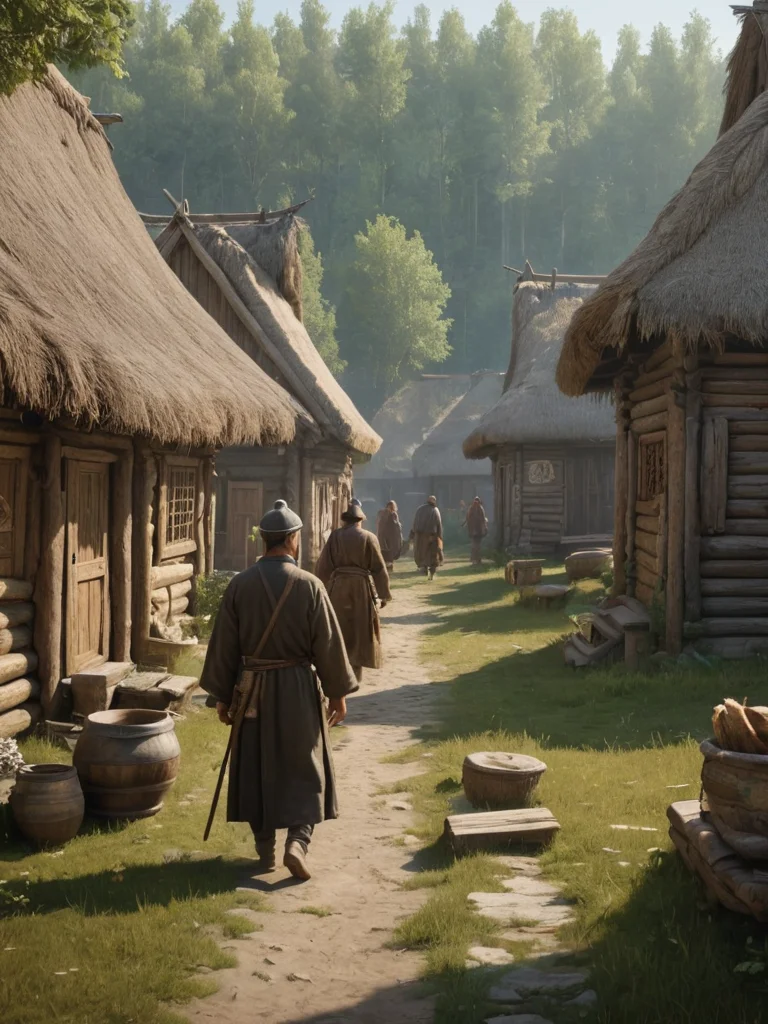
When we delve into the history of Ancient Rus’, our attention is often drawn to majestic princes, epic battles, and grand political intrigues. Chronicles meticulously record the deeds of rulers, the grandeur of churches, and the vicissitudes of internecine wars. However, behind these vivid pages of official history, a no less, and sometimes even more significant, part of the picture is often lost – the lives of millions of ordinary people, laborers, who, through their daily efforts, created the prosperity and culture of that time. It was their daily life, their joys and sorrows, their struggle for survival that formed the true fabric of ancient Russian society. It is impossible to understand Ancient Rus’ in its entirety without looking into humble huts, touching the calloused hands of plowmen, and listening to the whispers of ancient beliefs that guided the lives of our ancestors.
Historians and archaeologists, piecing together fragments of the past – from shards of pottery to entries in birch bark letters – strive to recreate this forgotten, yet extremely important, world. They seek answers to questions: what did an ordinary Rus’ person’s day look like? What did he eat, what did he wear? What fears plagued him, and in what did he find solace? In this article, we invite you on a fascinating journey through pre-Mongol Rus’ to explore together the daily lives of those who remained in the background of great chronicle events, but whose lives were the foundation for the entire civilization.
What We Know About the Lives of Ordinary People in Rus’: Discover the Daily Life of the Pre-Mongol Era
The era of Ancient Rus’, preceding the Mongol invasion (9th – early 13th centuries), was a period of rapid state formation, cultural flourishing, and intensive development. However, as mentioned, historical sources of that time, primarily chronicles and lives of saints, focused on the activities of the elite: princes, retinue members, and clergy. Information about the “silent majority” – peasants, artisans, low-level traders – is extremely scarce and fragmented. For a long time, historical science ignored this aspect, considering it less significant than political history.
Nevertheless, modern research, based on data from archaeology, ethnography (later data allowing for the reconstruction of daily life), linguistics, and even folklore, allows us to form a fairly detailed picture. Archaeological excavations of ancient settlements, burial mounds, and hillforts provide information about dwellings, tools, household items, and jewelry, which allows for the reconstruction of material culture. Birch bark letters, found mainly in Novgorod, have become a true window into everyday life, revealing correspondence between ordinary people, their economic calculations, even jokes and love letters, shedding light on their mentality and customs.
Thanks to these sources, we can confidently say that the lives of ordinary Rus’ people were inextricably linked to the land and nature. They were subject to the strict rhythms of the agricultural year, religious holidays, and rituals. It was a life full of challenges and hardships, but also of deep meaning, based on strong family and community ties, as well as deep beliefs that helped them cope with adversity. Understanding this daily dimension allows us not only to comprehend the past more deeply but also to better understand the roots of many modern cultural phenomena and national character traits.
Imagine a world without electricity, running water, where any journey is an adventure full of dangers. A world where life and death go hand in hand, where the harvest depends on the mercy of heaven, and defense against enemies on the strength of the community. This is not a fictional reality, but the daily life of pre-Mongol Rus’, where every day was a test of resilience and ingenuity. Let us immerse ourselves in this world and see how our ancestors lived day by day.
Home, Bread, and Labor: What Ordinary Rus’ People Did and How They Survived Day by Day
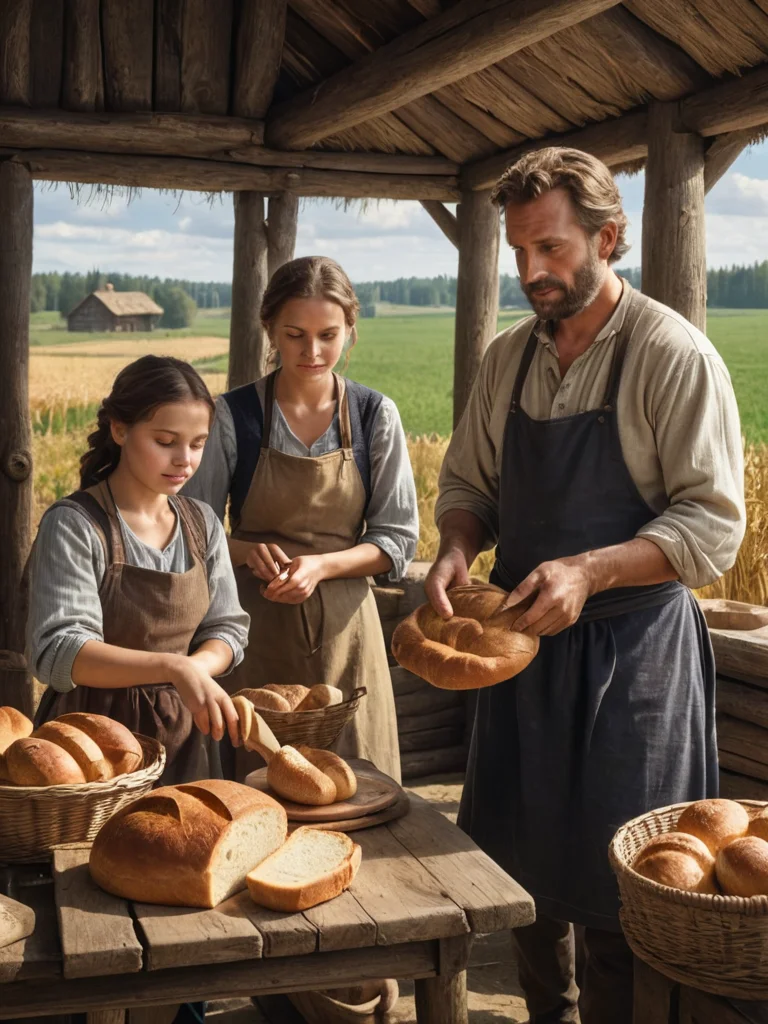
The life of an ordinary Rus’ person in the pre-Mongol era was closely intertwined with nature and subject to the cycle of agricultural work. From dawn till dusk, from spring to winter, each day was filled with labor aimed at survival and supporting the family. The foundation of everything was the home, or izba, as it was more commonly called. It was not just a dwelling, but an entire microcosm, the center of family life and a refuge from the harsh world.
Dwelling: The Heart of the Ancient Russian Family
Most izbas were log houses, built from thick logs laid without nails, and the joints were caulked with moss for warmth. There was usually no foundation – the logs were simply laid on the ground or on stones, which explains why many structures have not survived to this day. Izbas were single-room dwellings, meaning they consisted of one room where the entire family life took place. Sometimes a cold klet’ – an annex for storing provisions or for summer living – was attached to the izba.
In the center of the izba was the stove – not just a hearth, but a multifunctional device: it heated the house, food was cooked in it, bread was baked, people slept on it, and in some regions, they even bathed in it. Smoke from the stove either escaped through an opening in the ceiling (smoky izbas) or through a special smoke vent in the wall, and later – through a chimney. Lighting was primitive: a splinter of wood, and later – oil lamps. Furniture was simple: benches along the walls, a table, shelves. The space of the izba was strictly zoned: the red corner with icons (after the adoption of Christianity) or pagan amulets, the women’s corner near the stove, the men’s corner near the entrance.
Food: The Basis of Survival
The diet of an ordinary Rus’ person was simple but nutritious. The main product, of course, was bread. Rye, wheat, barley, and oats were grown everywhere. Bread was baked daily; it was a symbol of life and well-being. In addition to bread, the diet included porridges (buckwheat, millet, oatmeal), cooked in water or milk. In summer and autumn, vegetables appeared on the table: cabbage, turnip, radish, onion, garlic. Legumes – peas and beans – were an important source of protein. Wild berries, mushrooms, and nuts were consumed. Honey played an important role, serving as both a sweetener and a medicine.
Meat products were consumed infrequently and were more of a festive dish. Meat was obtained through hunting (game), livestock was raised (cows, pigs, sheep), as well as poultry (chickens, ducks). Fish was more accessible, especially for those living near rivers and lakes. Among the drinks, kvass, berry mors, and sbiten (a drink based on honey with herbs) predominated. Dairy products – milk, cottage cheese, sour cream – were also present in the diet, but depended on the availability of livestock on the farm.
Clothing: Practicality and Simplicity
The clothing of ordinary people was functional and made from available materials. The main raw materials were flax, hemp, and wool. Women spun threads themselves, wove linen, and then sewed clothes. Men wore shirts made of coarse linen, belted, and porty (trousers). Women’s clothing consisted of a long shirt, and on top – a kind of sarafan or poneva. In winter, sheepskin coats or tulups, often undyed, were worn over everything. Various headwear was worn – scarves for women, hats for men.
Footwear most often consisted of lapti – woven from bast or birch bark, which were light and cheap, but not durable. More prosperous peasants or townspeople could afford leather boots. Clothing did not differ in special variety or decoration, but was adapted to harsh climatic conditions and heavy physical labor.
Labor: The Daily Struggle for Life
The basis of the economy of Ancient Rus’ was agriculture. The majority of the population lived in villages and engaged in plowing. In the northern forest regions, slash-and-burn agriculture was practiced: forests were cleared and burned, ash fertilized the soil, and grain was sown on this plot for several years until the land was depleted, after which they moved to a new plot. In the south, in more fertile lands, fallow farming was used: a plot of land was cultivated for several years, then left to “rest” for a long time, overgrown with grass.
The main agricultural tools were simple: a plow for plowing, a harrow for loosening the soil, a sickle for harvesting, a flail for threshing. All work was done manually or with the help of draft animals (oxen, horses). Agriculture was not the only occupation. Animal husbandry, hunting, fishing, and beekeeping (collecting wild honey) supplemented the diet and provided raw materials for life. Each household, in essence, was a self-sufficient farm.
Crafts also played an important role. Although specialized artisans existed in the cities, in the villages, many skills were universal. Men knew how to do carpentry, joinery, and forge simple tools. Women – weaving, spinning, sewing. Pottery, leatherworking – all this was part of everyday life. Labor was hard, requiring endurance and a deep knowledge of nature and its cycles. But there was also a collective component: community mutual aid, or toloka, when villagers helped each other with particularly labor-intensive tasks (e.g., building a house or harvesting).
Beliefs, Holidays, and Family Ties: The Spiritual World and Social Connections of the Pre-Mongol Person
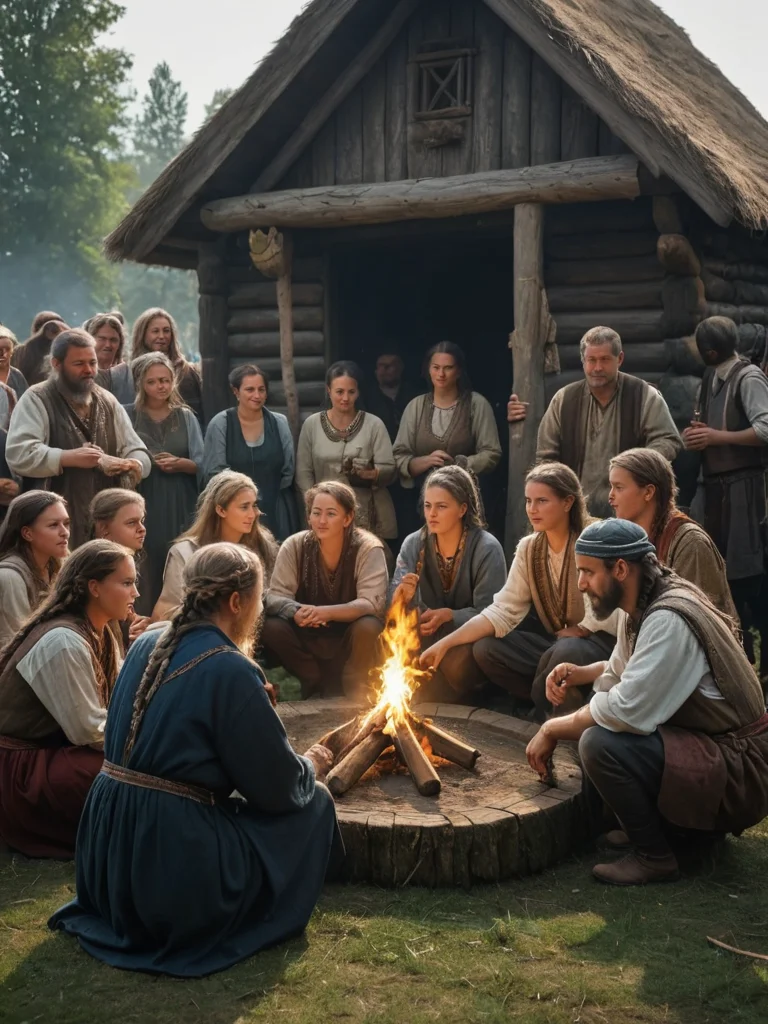
The life of an ordinary person in Rus’ before the Mongol invasion was not limited to physical labor and the struggle for survival. His world was filled with deep beliefs, complex social ties, and a rich ritual life. These aspects shaped his worldview, determined his place in society, and gave him the strength to withstand hardships.
Family: The Foundation of Everything
The foundation of ancient Russian society was the large, or, as historians call it, the undivided family, which included several generations of relatives living under one roof and managing a common household. The head of such a family was the eldest man – the bol’shak, or khozyain (master), who made all important decisions. The woman, the bol’shukha or khozyayka (mistress), managed the internal affairs of the house, raised children, and engaged in women’s work (spinning, weaving, cooking). The man was the provider, the farmer, the defender.
Children were an integral part of the family, and their birth was considered a blessing. High child mortality was a harsh reality, which explains the desire for many children. From an early age, children were accustomed to labor, learning skills necessary for survival. Marriages were concluded early, often by agreement between families, to strengthen kinship and economic ties. Weddings were significant events, accompanied by many rituals and songs aimed at ensuring the fertility and well-being of the new family.
Community: Mutual Responsibility and Mutual Aid
The most important social unit was the community, or verv’ (in ancient Russian sources). Peasants did not live in isolation but as part of communities that owned land collectively and then distributed it among families. The community served as a kind of “social insurance”: it provided mutual aid in case of misfortune (fire, crop failure, illness), acted as a collective guarantor to the prince or state (joint responsibility), and resolved internal disputes at village assemblies. It was a survival mechanism in conditions of instability and the absence of developed state institutions.
Decisions at assemblies were made collegially, giving the ordinary person a certain degree of participation in managing his life, albeit within limited boundaries. The community also organized common holidays, rituals, maintained order and traditions. Separation from the community, expulsion from it, was one of the most terrible punishments, as it meant the loss of protection and support.
Paganism: Ancient Roots of Beliefs
Before the adoption of Christianity in 988, and in many rural areas for much longer, the spiritual world of the Rus’ person was permeated with pagan beliefs. It was a system based on the deification of the forces of nature and ancestors. People believed in many gods (Perun – god of thunder and lightning, Veles – patron of cattle and wealth, Mokosh – goddess of fertility and fate, Yarilo – god of the sun and spring), spirits of the forest (leshy), water (vodyanoy), house (domovoy), bathhouse (bannik). These spirits could be both benevolent and dangerous, and they had to be appeased with sacrifices, rituals, and incantations.
The entire life cycle – birth, marriage, death – was surrounded by magical rituals. The agricultural year was also marked by pagan holidays associated with fertility and the changing seasons: Maslenitsa (farewell to winter), Kupala (summer solstice), Osenniny (harvest festival). People wore amulets, believed in omens, divined, and consulted volkhvy (pagan priests). This worldview provided a sense of control over the unknown and explained what was happening in the world.
Adoption of Christianity and Dual Faith
The baptism of Rus’ by Prince Vladimir in 988 was a turning point, but the process of Christianization of ordinary people was long and complex. Especially in rural areas, pagan traditions did not disappear but intertwined with the new faith, forming a unique phenomenon – dual faith. People continued to honor old gods and spirits, perform pagan rituals, but at the same time attended churches, were baptized, and placed icons.
Christianity brought with it a new morality, new holidays (Easter, Christmas, Trinity), new rituals (baptism, wedding, funeral services). Churches began to appear, first in cities, and then in large villages. Priests became a new figure in the community, alongside volkhvy and healers. For many peasants, the new faith was perceived as another form of magic, capable of helping in everyday life and protecting them from hardships. This symbiosis of old and new formed a unique spiritual culture that is still evident in Russian folklore and folk customs today.
Culture and Leisure: Songs, Games, and Tales
Despite the hard work, there was also room for leisure in the lives of ordinary Rus’ people. Winter evenings were a time for needlework, storytelling, and singing. Oral tradition flourished widely: bylinas (epic songs about heroes), fairy tales, proverbs, riddles were passed down from generation to generation, reflecting folk wisdom and worldview. Holidays featured games, round dances, and youth entertainment. Skomorokhi – wandering performers – entertained the people with songs, jokes, and acrobatic acts. All this created a rich cultural space that united people and helped them cope with the hardships of everyday life.
Facing Difficulties: How Ordinary People Dealt with Illness, Hunger, and the Harsh Climate of Ancient Rus’

The life of an ordinary person in pre-Mongol Rus’ was a continuous series of trials. Natural disasters, diseases, conflicts – all were part of everyday reality. Survival required not only physical strength and diligence but also extraordinary resilience, ingenuity, and solidarity.
Harsh Climate and the Threat of Hunger
The geographical location of Rus’ with its long and frosty winters, short summers, and variable climate created a constant threat of crop failure. Historians note that hunger was a frequent companion in the lives of our ancestors. Chronicles are full of mentions of “great famines” when people died by the thousands, and survivors were forced to eat tree bark, moss, and straw. Droughts, heavy rains, and early frosts could destroy the entire harvest, condemning entire communities to starvation.
To combat hunger, people used various strategies. Firstly, it was stockpiling reserves: grain was stored in special pits or granaries, and vegetables in cellars. However, reserves were limited. Secondly, gifts of the forest were actively used: mushrooms, berries, wild nuts, which were collected in large quantities and preserved for the winter. Hunting and fishing also helped diversify the meager diet. Thirdly, in years of severe famine, people were forced to leave their lands and seek sustenance in other regions or even sell themselves into slavery to survive. These hardships tempered character but were also the cause of many popular uprisings and rebellions.
Illnesses and Folk Medicine
Medicine in the modern sense was absent. Hygiene was at a low level, although ancient Rus’ people regularly visited baths, which had not only a cleansing but also a sacred significance. However, overcrowding in izbas and lack of sanitation in settlements contributed to the spread of diseases. Epidemics of plague, smallpox, typhus, and dysentery were a scourge of the population and claimed many lives. Child mortality was catastrophically high, and only a small fraction of those born survived to adulthood.
For treatment, methods of folk medicine were used. Healers and wise women, possessing knowledge of the medicinal properties of herbs, roots, and berries, were the main healers. They used various infusions, decoctions, compresses, as well as incantations and rituals, believing in the magical power of words and nature. Bone-setters knew how to reduce dislocations and fractures. Some methods, such as bloodletting or cauterization, were also used. However, these remedies were powerless against mass epidemics, and people often relied on faith in God (after baptism) or pagan spirits, praying for salvation.
External Threats and Internal Strife
The life of an ordinary Rus’ person was overshadowed not only by natural disasters and diseases but also by constant military threats. Nomadic steppe tribes – Polovtsians, Pechenegs – regularly raided Russian lands, driving away cattle, taking people captive (slavery), and devastating villages. Defense against them fell on the shoulders of princely retinues, but often ordinary people had to defend themselves, hiding in forests or fortified settlements.
No less dangerous were the internecine wars of the princes. In the struggle for power and territory, princes did not stop at devastating foreign, and sometimes their own, lands. Armies marched through villages, took provisions, horses, and men could be conscripted into the militia. This undermined the economy and destabilized life. The system of collecting tribute (polyudye), when princes with their retinues traveled around their domains and collected produce and furs from the population, was also a heavy burden for the peasants.
In the face of these numerous difficulties, the survival of the community depended on cohesion and mutual aid. People relied on each other, shared the last piece of bread, helped rebuild homes after fires or raids. This strengthened community ties and formed a unique mentality where collective survival was valued above individual well-being.
The Legacy of Ancestors: Why It’s Important to Remember the Lives of Ordinary People of Ancient Rus’ and What It Tells Us Today

We have journeyed through centuries, peered into humble huts, observed hard labor in the fields, and felt the beliefs of pre-Mongol Rus’. Perhaps for some, this picture may seem overly harsh or even primitive. However, it was in this simplicity, in this constant struggle for existence, that those traits were forged which would later become the foundation of Russian civilization and national character. Understanding the lives of ordinary people of Ancient Rus’ is not just an academic interest; it is the key to understanding our own cultural roots and values.
First and foremost, the life of a pre-Mongol Rus’ person teaches us resilience and ingenuity. In conditions of constant threat of hunger, disease, and enemy raids, people learned to make the most of nature’s resources, adapt to any conditions, and find solutions to the most complex situations. This legacy is manifested in the amazing ability of the Russian people to survive and recover after the most terrible trials.
Secondly, we see the incredible strength of community ties and mutual aid. In an era when state institutions were still weak and personal safety was not guaranteed, it was the community that became the main support. Collective labor, joint responsibility, support in times of trouble – all this fostered a deep sense of unity and responsibility for each other. This spirit of collectivism, of sobornost (conciliarity), although transformed over time, remains an important feature of Russian society.
Thirdly, the deep connection with nature and its cycles, permeated by ancient pagan beliefs and then Christian spirituality, formed a special worldview. People lived in harmony with the surrounding world, understanding its laws and obeying its rhythms. This taught them patience, humility in the face of the elements, but also deep respect for the earth, the nourisher. Many folk holidays, customs, and even elements of the Russian language still carry echoes of this ancient worldview.
Studying the daily life of pre-Mongol Rus’ also allows us to debunk many myths and stereotypes, to understand that history is not only the deeds of the great but also millions of small stories that form a common mosaic. It is a reminder that the foundation of any civilization is the labor and daily life of ordinary people, their beliefs and hopes. Today, in an era of rapid change and globalization, turning to this simple but profound legacy of our ancestors helps us to better understand ourselves, to recognize the origins of our traditions, and to strengthen our connection with the past. This allows us to appreciate not only heroic deeds but also the invaluable contribution of every person who, through their daily labor, built Rus’, transforming it into the great state we know today.